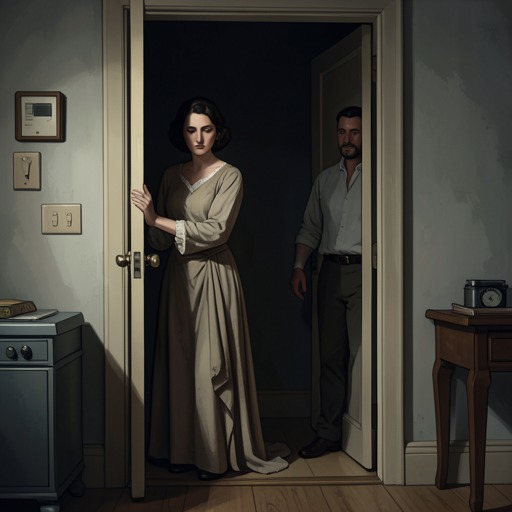
Doc Golightly
Breakfast at Tiffany'sDoc Golightly is the Texas horse doctor who arrives in New York City looking for Holly Golightly, whom he knows as Lulamae Barnes, his young wife. His account of their marriage overturns the narrator’s assumptions about Holly’s past: she had been a neglected, impoverished child, taken in with her brother Fred and married by Doc when she was nearly fourteen. Doc’s patient hope that she will return home meets Holly’s tenderness but not her consent. Their reunion makes the difference between being loved as part of a family and choosing to belong to it the decisive fact of his story.
Identity and Background
Doc identifies himself as Holly’s husband, not her father, after the narrator initially mistakes him for a parent. Holly was born Lulamae Barnes; she took the name Holly after marrying Doc. He describes himself as a horse doctor and animal man who also farms near Tulip, Texas. By the time he comes to find her, he has spent five years searching, and has learned her New York address from a letter sent by Fred, who is serving in the Army.
Doc’s understanding of the family is shaped by the household he and his children made for Lulamae and Fred. The two siblings had been found stealing milk and turkey eggs after their parents died and they were sent to live with different, unkind people. Doc’s daughter Nellie brought them into the house. He remembers them arriving thin, weak, and neglected; under his roof, Lulamae grew healthier, and Fred grew into a strong young man. Doc’s account thus locates the marriage within a rescue and household-making story, even as its circumstances make clear how young Lulamae was.
Marriage and Family Life
Doc says that he married Lulamae in December 1938, when she was going on fourteen. He distinguishes the four children in the family photograph from her natural-born children: they were his children from an earlier marriage, and their mother had died on Independence Day in 1936, the year of the drought. He believed Lulamae had knowingly promised to be his wife and their mother, and that her departure broke the family’s heart. His conviction treats the promise as a lasting bond; Holly later disputes the marriage’s legal force because she was only fourteen.
His recollections present a home he experienced as affectionate and secure. Doc says the children did the housework, leaving Lulamae free to eat pie, fix her hair, look at magazines, and take it easy. He recalls collecting flowers for her, taming a crow and teaching it to say her name, and showing her how to play guitar. He says he cried when he proposed and remembers her accepting him with the assurance that she had never been married before. These details reveal both his fondness and the unequal meanings the pair attach to the marriage: he recalls a happy, settled family, while Holly’s later account recalls a childhood identity she had to escape.
Doc connects her departure to the magazines that came into the house. In his telling, their pictures and imagined lives stirred Lulamae to walk a little farther from home each day, until one day she did not return. The crow he had taught to call her name flew away, but could still be heard through the summer in the yard, garden, and woods. Its repeated call becomes an image of the home Doc remembers and of the person he continues to seek, even after she has made a life elsewhere.
The Search for Holly
Fred’s letter gives Doc the address that brings him to New York City. He travels by Greyhound, determined to find his wife, and asks the narrator to help prepare her rather than surprise or frighten her. Doc believes she is sorry for leaving and wants to return; the narrator warns him that she may have changed. His request for a friend, and his shy concern about whether he looks presentable before meeting her, show how much hope he has invested in this reunion.
Before the encounter, Holly has been telling the narrator that she visits a prisoner by claiming to be his niece, with the lawyer paying her after she delivers a weather report. Doc’s arrival interrupts the narrator’s assumptions about her past with a different, previously concealed family identity. When Holly learns that he is there, she removes her dark glasses, recognizes what the narrator has told her, and rushes to find him, calling down the stairs for Fred. The eagerness of that first response is not a promise to return; it is the shock of hearing that the people and names she has left behind have found her.
Reunion and Parting
Doc climbs the stairs and addresses Holly as Lulamae. At first, she looks at him as if she cannot place him. He notices how thin she is and recalls the wild-eyed child he first knew. Holly touches his face, testing his chin and stubble as if confirming that he is real, then greets him gently and kisses his cheek. Doc lifts her in a crushing embrace, laughing with relief. Their bodily reunion briefly bridges the years and the names by which they know her: he addresses his wife as Lulamae, while she answers him as Doc.
The next morning, Holly explains that she never divorced him because she thought a marriage contracted at fourteen could not have been legal. She defends her belief emphatically, even warning the narrator to keep it secret. After spending the night with Doc, she tells the narrator that he truly loves her and that she loves him. She recognizes his sweetness in the confidence he gives to birds, children, and fragile things, and says she has remembered him in her prayers. Her affection is real, but it does not erase her sense that she is no longer the girl he came to take home.
The two spend the night roaming around a bus station. Doc believes until the last moment that Holly will go with him, although she keeps telling him that she is no longer fourteen and is not Lulamae. Holly’s painful qualification is that she still feels, in some deeper sense, like the child who stole turkey eggs and ran through a briar patch; she now names that unsettled fear the mean reds. The reunion therefore ends not in restoration but in a distinction Holly can articulate: the child Doc remembers remains part of her, yet cannot simply be returned to his household.
Narrative Role and Significance
Doc’s arrival turns Holly’s self-invention into a concrete family history. The distinction between her adopted adult name and her childhood name is not merely a disguise: it marks the gap between a person formed by escape and the people who remember her as belonging to a home. The story gives Doc’s memories their full tenderness—flowers, the crow’s call, children, and a marriage proposal—without making them sufficient grounds for Holly’s return.
His role also complicates a simple opposition between abandonment and devotion. Doc has spent years looking for his wife and approaches her with care, yet his confidence that she wants to come home cannot determine what she wants now. Holly, in turn, does not deny his love or the comfort he once gave her; she acknowledges both while refusing to be returned to the identity of a fourteen-year-old bride. Their parting preserves the emotional truth of the bond while showing that affection and remembered family obligations cannot undo the changes time and self-making have wrought.